Wood Tariffs Explained: What Pallet Buyers Need to Know
A change in wood tariffs can raise an immediate question for purchasing teams: What will this mean for our pallet costs?
The answer depends on more than the percentage in a headline. The type of wood product, its country of origin, applicable trade measures, and the way your supplier sources materials all matter. A tariff on imported lumber also affects a different stage of the supply chain than a tariff on a finished wood product.
For pallet buyers, understanding those distinctions makes it easier to evaluate price changes, discuss sourcing options, and plan purchases.
Here is how wood tariffs work and what to consider when reviewing your pallet program.
What Are Wood Tariffs?
A tariff is a duty imposed on imported goods. Some tariffs are calculated as a percentage of the goods’ customs value, while others use different methods.
In the United States, according to U.S. Customs and Border Protection, the importer of record is responsible for paying applicable duties. A customs broker may manage the entry and payment process on the importer’s behalf.
That legal responsibility is separate from how businesses ultimately distribute the cost. An importer may absorb some of an increase, negotiate with a supplier, adjust selling prices, or change sourcing. The effect on a downstream buyer depends on those commercial decisions and market conditions.
The phrase “wood tariffs” covers a broad category. Logs, sawn lumber, plywood, wood packaging, and furniture are different products, and they should not be assumed to receive the same tariff treatment.
Why Are Tariffs and Other Duties Applied to Wood?
Different trade measures have different legal purposes.
Section 232 measures address imports determined to threaten national security. Other measures may respond to particular trade practices or disputes.
Antidumping and countervailing duties are separate trade remedies. Antidumping duties address dumping, broadly involving sales at less than normal value. Countervailing duties address certain government subsidies. These measures follow investigations and can apply to specified products and producers.
For buyers, the practical distinction is that one tariff announcement may not describe the entire duty burden on an imported product. Multiple measures can apply, and the rules determine which duties are combined or excluded.
Current Wood Tariff Considerations
Policy information reviewed October 30, 2026.
There is no single tariff rate that applies to every wood product imported into the United States. Several measures are relevant to forest products, particularly imports from Canada.
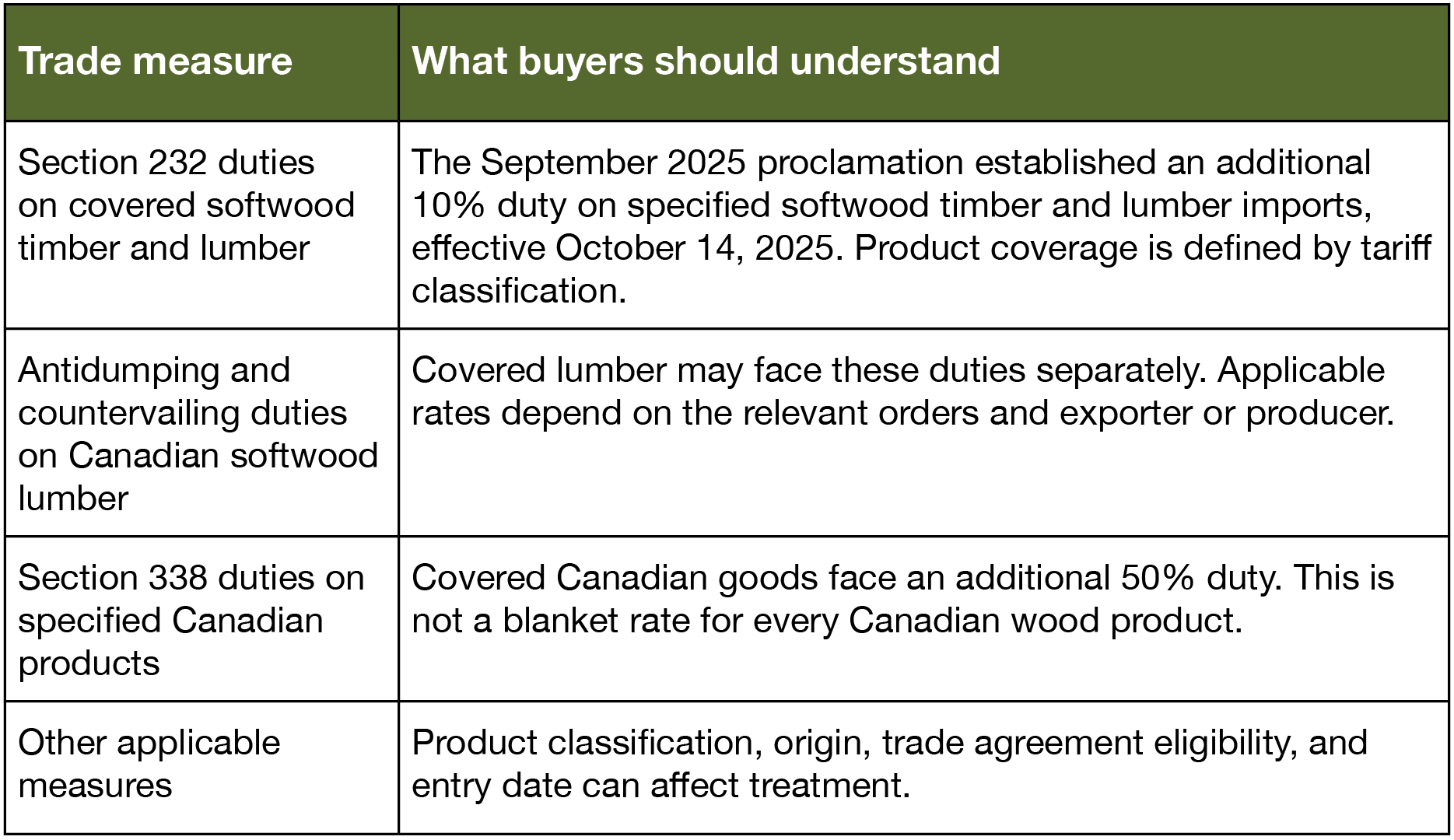
The original Section 232 lumber measure is documented in CBP’s implementation guidance. Global Affairs Canada also identifies multiple U.S. trade measures that can affect Canadian forest products, including softwood lumber duties and Section 232, Section 301, and Section 338 tariffs. Canadian government overview
Recent changes make product-level review especially important. An October 23, 2026 proclamation changed the Canadian products covered by the additional 50% Section 338 duty, effective October 30, 2026. It also states that the Section 338 duties apply in addition to applicable Section 232 duties. The proclamation’s annexes identify the affected classifications. October 2026 proclamation
A business importing wood products should confirm the current treatment of its specific goods with its customs broker. For a pallet buyer purchasing domestically, the useful question is how those measures affect the supplier’s actual materials and quoted price.
Imported Lumber and Imported Pallets Are Different
Lumber used to manufacture a pallet and the finished pallet itself are distinct products for customs purposes.
A tariff announcement about softwood lumber should not automatically be interpreted as a statement about the duty on finished pallets. Likewise, the treatment of one wood packaging product should not be extended to every crate, pallet, or packaging component.
The starting point is the product’s correct classification in the U.S. Harmonized Tariff Schedule, followed by the applicable origin rules and additional duty provisions.
This distinction also matters when discussing a supplier’s price increase. Ask whether the change concerns imported raw material, a finished imported product, or a broader shift in material availability.
How Can Wood Tariffs Affect Pallet Prices?
Tariffs can influence pallet costs through several possible paths. A manufacturer using covered imported lumber may experience a direct increase in its material acquisition costs. It may then review prices, sourcing, inventory, or production plans.
Changes in sourcing can also affect the broader market. If buyers shift toward alternative lumber sources, demand and availability may change. Domestic lumber prices therefore do not necessarily remain unaffected by tariffs on imports.
These are possible market effects, not a prediction that every pallet price will rise. Actual outcomes depend on demand, inventories, regional supply, and purchasing arrangements.
A finished pallet’s cost also includes more than lumber. Other factors can include:
Cutting and assembly labor.
Fasteners and other components.
Treatment or drying, when required.
Plant operations and handling.
Freight and delivery.
Inspection, sorting, and repair for recycled pallets.
A tariff percentage should not be applied directly to the full price of a pallet without understanding the cost involved.
A Simple Cost Example
Consider a hypothetical pallet that costs $20. Assume $8 of that price represents a material cost affected by a 10% increase. If the entire $8 component rises by 10%, the increase is $0.80. With every other cost unchanged and that increase passed through dollar for dollar, the resulting price would be $20.80—a 4% increase.
This is an arithmetic illustration, not a tariff calculation or an Olympic Forest Products quote. It shows why a percentage change affecting one cost component does not necessarily produce the same percentage change in the finished pallet price.
Are Recycled Pallets Affected by Wood Tariffs?
Recycled pallets can reduce the need for new material by keeping existing pallets and components in service. That can make them a useful option to evaluate when lumber costs change.
However, recycled pallets are still part of the larger pallet market. Repairs may require replacement lumber, and increased demand for recycled pallets can affect availability and pricing. Transportation, sorting, labor, and the supply of repairable pallets also matter.
The right comparison is between pallets that meet the same operating requirements. A recycled option should be evaluated for condition, construction, load suitability, equipment compatibility, and customer acceptance.
A lower purchase price provides limited value if the pallet causes rejected deliveries, product damage, or handling problems.
What Can Pallet Buyers Do?
Ask What Is Driving the Quote
When a price changes, ask your supplier to explain the main causes. The change may relate to tariffs, lumber availability, freight, labor, pallet condition, or a combination of factors.
Useful questions include:
Which part of the supply chain is affected?
Does the change apply to all of our pallet specifications?
How long is the quote valid?
Are there suitable alternatives at a different cost?
A clear explanation makes it easier to budget and compare options.
Review the Pallet Specification
A pallet specification should reflect the work the pallet needs to perform. Requirements carried forward from an old product, warehouse, or customer may deserve another look.
Review product weight, load distribution, deck coverage, handling equipment, storage conditions, and shipping destination. Any proposed material or construction change should be evaluated against those requirements.
Olympic Forest Products’ custom pallet design services can help buyers examine whether a different design would suit the application.
Compare Suitable New and Recycled Options
Some operations need new pallets built to a precise specification. Others can use appropriately selected recycled or repaired pallets.
Consider the full application, including customer requirements and automated equipment. Pallets that share the same footprint are not necessarily interchangeable.
Share Demand Forecasts
Give your supplier advance visibility into seasonal peaks, production changes, new facilities, and planned promotions.
Better information supports discussions about delivery schedules and inventory levels. Olympic Forest Products offers pallet management and inventory services that include customized inventory planning.
Evaluate Cost per Successful Use
Purchase price is one part of pallet cost. Also consider product damage, handling time, repairs, recovery, disposal, and the number of usable trips.
For a returnable pallet program, a higher initial price may be justified by reliable reuse. For a one-way shipment, a different specification may be appropriate. Evaluate each option against the way your business actually uses pallets.
Frequently Asked Questions About Wood Tariffs
Do wood tariffs apply to every type of wood?
No. Treatment depends on the product, classification, origin, and applicable measures. A rule affecting specified softwood lumber should not be assumed to apply identically to hardwood lumber or finished wood packaging.
Does buying U.S.-made pallets eliminate tariff exposure?
It may reduce certain direct import exposures, but the pallet’s manufacturing location does not by itself establish the origin of every material. Domestic purchasing can also be affected by broader changes in lumber supply and demand.
Do higher tariffs always mean higher pallet prices?
No. Tariffs are one potential cost factor. Inventory, sourcing, demand, and commercial agreements influence whether and when a supplier changes its price.
Are recycled pallets protected from tariff-related price changes?
Recycled pallets use existing material, but repair costs, availability, and market demand can still affect their pricing.
Where should importers check current rates?
Start with the current Harmonized Tariff Schedule and applicable CBP guidance. A customs broker can help determine how classification, origin, entry date, and overlapping trade measures apply to a particular shipment.
Plan Your Pallet Purchases with Better Information
Wood tariffs add another consideration to pallet purchasing. Understanding the actual source of a cost change helps you respond with a suitable specification, sourcing plan, and inventory strategy.
At Olympic Forest Products, we work with businesses to evaluate pallet requirements in the context of their operations. Whether you are comparing new and recycled options, reviewing a custom design, or planning future demand, our team can help you assess the choices available.