
Pallets are essential to your supply chain—but does your company need to own them?
For businesses that ship products regularly, the decision often comes down to two options: participate in a pallet pooling program or purchase pallets outright. Both approaches can work. The better choice depends on your shipping network, pallet specifications, customer requirements, recovery capabilities, and total operating costs.
Pallet pooling can reduce the burden of owning, recovering, repairing, and replacing pallets. Purchasing pallets, on the other hand, gives a business greater control over pallet design, supply, and use.
There is also a third option: combine pallet ownership with a professionally managed retrieval and repair program.
This guide compares the three approaches so you can determine which pallet strategy best fits your operation.
What Is Pallet Pooling?
Pallet pooling is a shared-use system in which a provider owns a fleet—or “pool”—of reusable pallets. Customers rent or pay to use those pallets rather than purchasing them.
A typical pallet pooling cycle works like this:
The pooling provider supplies pallets to a manufacturer or shipper.
The shipper loads its products and sends them to a customer, retailer, or distribution center.
The empty pallets are collected from the receiving location.
The pooling provider inspects and repairs the returned pallets.
Serviceable pallets go back into the pool for another trip.
Instead of remaining with one company throughout their useful lives, pooled pallets circulate among multiple participants.
Large pool providers commonly use standardized wood or plastic pallets. Their models are designed around repeated use, asset recovery, inspection, repair, and redistribution.
What Does Buying Pallets Outright Mean?
When you buy pallets outright, your company owns them. Depending on your operation, those pallets may be:
Used for a single outbound shipment
Sold or transferred with the product
Exchanged with a customer or carrier
Recovered for repeated use
Repaired and returned to inventory
Recycled when they reach the end of their useful lives
Ownership gives you control over the pallet’s design, material, condition, and destination. It also makes your business responsible for forecasting demand, maintaining inventory, inspecting pallets, coordinating recovery, and replacing damaged or missing units.
Those responsibilities do not necessarily need to be handled internally. A pallet management partner can support sourcing, storage, delivery, retrieval, inspection, repair, reporting, and recycling while the customer maintains an owned pallet program.
Pallet Pooling vs. Buying: A Quick Comparison
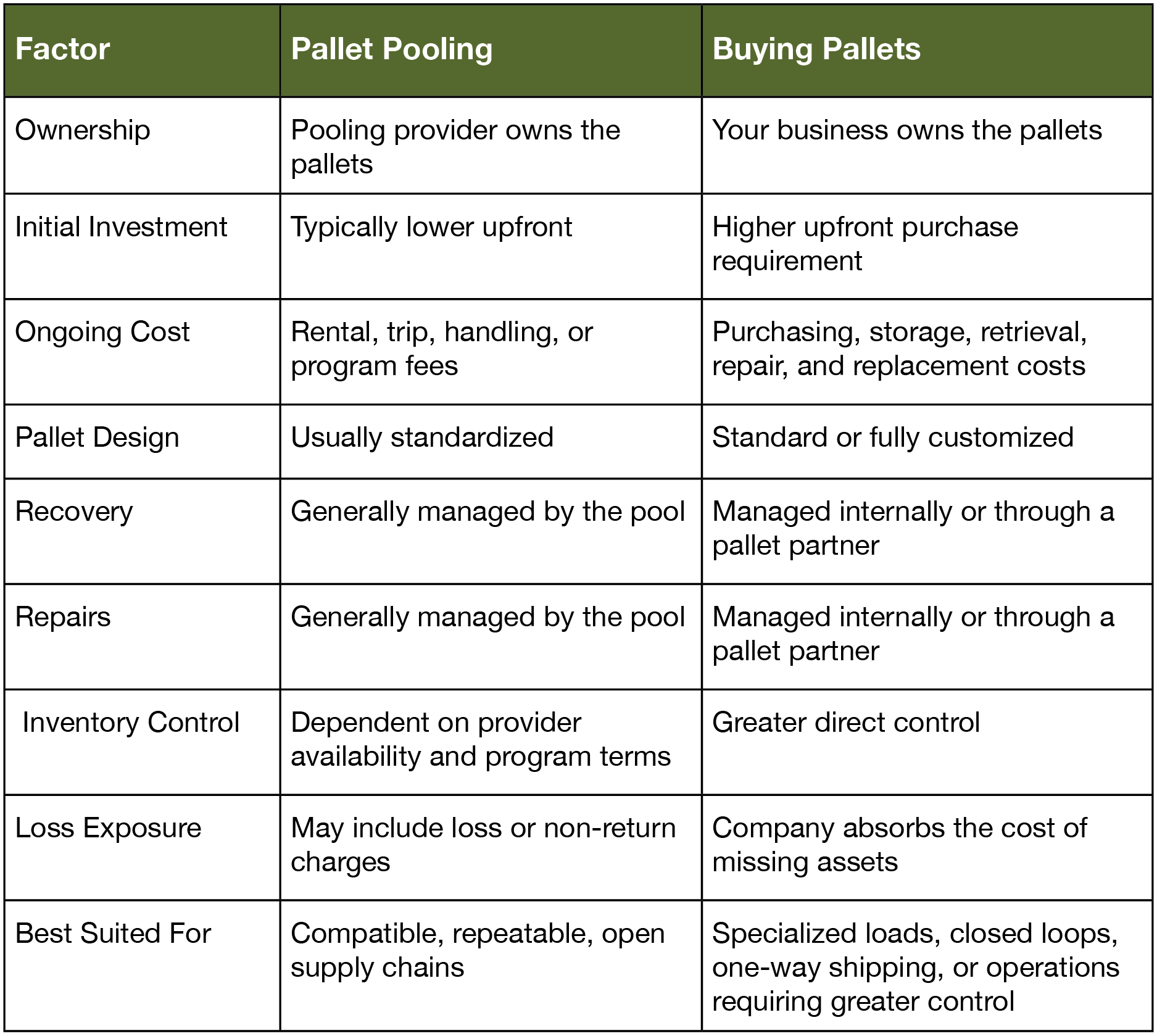
The true comparison is not simply rental price versus purchase price. It is the total cost and operational impact of keeping the right pallets available throughout your supply chain.
Let’s dive in deeper to the benefits vs. drawbacks of both, starting with pallet pooling.
5 Benefits of Pallet Pooling
In our experience, there are several benefits to pallet pooling, including:
1. Lower Initial Capital Requirements
Because the pooling provider retains ownership, your business does not need to purchase an entire fleet. This can reduce the upfront investment required to support regular or seasonal shipping volumes.
Pooling can convert part of your pallet expense from an asset purchase into a usage-based operating cost.
2. Outsourced Recovery and Repair
Recovering empty pallets from customers, retailers, and distribution centers takes coordination. Pallets must be identified, sorted, transported, inspected, repaired, and placed back into circulation.
In a traditional pallet pooling program, much of this work is handled by the provider. That can reduce the internal labor and infrastructure required to manage reusable pallets.
3. Access to Standardized Pallets
Pooled pallets are generally built and maintained to a defined specification. Consistent dimensions and construction can support predictable performance in racking, conveyors, palletizers, and other material-handling systems.
However, businesses should confirm that the pool’s pallet specification is appropriate for their product, load, equipment, and customer requirements.
4. Flexibility During Demand Changes
A pooling program may allow a business to adjust pallet quantities as shipping volume changes. This can be helpful for seasonal operations or companies that would otherwise need to purchase and store enough pallets to cover peak demand.
Availability, lead times, minimums, and fees vary by program, so projected peak requirements should be discussed before making a commitment.
5. Support for Reuse
Pallet pooling is built around repeated use. Returned pallets are evaluated and, when appropriate, repaired and returned to circulation.
Keeping serviceable pallets in use for multiple trips can reduce the need for replacement platforms and support broader waste-reduction goals.
5 Potential Drawbacks of Pallet Pooling
In contrast, let’s also review the potential drawbacks of pallet pooling:
1. Limited Customization
Many pallet pools rely on standardized designs to make circulation, inspection, and repair more efficient. That works well when a standard pallet meets the application. It may not work as well for:
Oversized or unusually shaped products
Heavy or unevenly distributed loads
Specialized racking systems
Sensitive manufacturing environments
Export shipments
Operations requiring nonstandard materials or dimensions
If the unit load requires a custom pallet, buying may provide better control and performance.
2. Program and Trip Fees
Pooling may eliminate the purchase price, but it does not eliminate pallet costs. Depending on the agreement, expenses may include rental or issue fees, daily or dwell charges, transfer fees, transportation charges, recovery charges, lost-pallet penalties, and/or administrative or service fees.
Review the complete fee structure and model it against actual pallet flows—not just ideal return conditions.
3. Tracking and Reporting Requirements
A successful pool depends on knowing where its assets are. Participants may need to report pallet movements, transfers, balances, and destinations through the provider’s system.
If shipment data is late or inaccurate, the company may encounter reconciliation problems or unexpected charges. Before joining a pool, determine who will own reporting responsibilities and how the program will connect with current processes.
4. Dependence on the Provider’s Network
Pallet pooling works best when the provider can efficiently serve the locations where pallets originate and end their trips.
If your customers, warehouses, or delivery points fall outside the provider’s most efficient recovery network, costs and complexity may increase. Businesses should map actual shipping lanes and receiving locations before choosing a program.
5. Retailer and Customer Compatibility
Do not assume every customer accepts every pooled pallet. Certain retailers or facilities may require specific pallet types, grades, dimensions, materials, or pool providers.
Confirm acceptance requirements with major customers before changing pallet programs.
4 Benefits of Buying Pallets Outright
The benefits of owning your pallets include:
1. Greater Control
Ownership gives your business direct control over pallet specifications, purchasing quantities, inventory levels, and deployment. You can determine everything from material of the pallets to branding. That control can be especially valuable when pallet performance is closely connected to product protection, warehouse automation, or customer compliance.
2. Custom Pallet Design
A standard pallet is not always the most cost-effective choice. A pallet designed for the actual unit load can reduce product damage, eliminate unnecessary material, improve trailer utilization, and perform more reliably in storage and handling.
3. Flexibility Across Customers and Destinations
Owned pallets can be useful when products move through diverse channels that do not participate in the same pool. They may also make more sense for one-way shipments, low-return lanes, exports, construction applications, industrial packaging, or customers with different receiving requirements.
4. Potential Long-Term Value in Closed Loops
Ownership can perform well in a closed-loop supply chain where pallets travel between a limited number of known facilities.
If pallets can be recovered consistently, inspected, repaired, and returned to service, the cost can be spread across multiple trips. The key is having an effective recovery process.
Our Advice: When Does Pallet Pooling Make the Most Sense?
Pallet pooling may be a strong option when:
Your customers accept the pool’s pallet
Your shipping lanes align with the provider’s network
A standard pallet supports your unit load
Shipment volumes are high or variable
Pallets move through open supply chains
Internal recovery would be difficult
You want to outsource inspection and repair
Your team can reliably report pallet movements
Program fees remain competitive under realistic conditions
Pooling is particularly attractive when the operational burden of owning pallets would outweigh the benefits of direct control.
5 Potential Drawbacks of Buying Pallets
And, the potential drawbacks of buying your own pallets include:
1. Upfront Purchasing Costs
An owned program requires enough inventory to support normal demand, seasonal peaks, shipping delays, repair cycles, and unexpected disruptions. Buying too few pallets can interrupt production. Buying too many can tie up cash and warehouse space.
2. Storage Requirements
Empty pallets need to be stored safely while awaiting use, inspection, repair, or return. A poorly managed inventory can consume dock and yard space and create handling inefficiencies.
3. Retrieval and Transportation
Once an owned pallet leaves your facility, it may become difficult or expensive to recover. The business must determine:
Where empty pallets accumulate
Who is responsible for returning them
How they will be identified
When collection becomes economical
Whether backhaul capacity is available
How loss will be measured
Without a recovery plan, a reusable pallet may unintentionally become a one-way pallet.
4. Inspection and Repair
Recovered pallets must be inspected before being used again. Damaged pallets may require repair, recycling, or replacement. The cost of labor, replacement components, equipment, space, transportation, and quality control should be included when calculating the total cost of an owned fleet.
5. Pallet Loss
Owned pallets can be misplaced, discarded, exchanged, or absorbed into another company’s inventory. Loss reduces the number of trips achieved per pallet and can quickly change the economics of a reusable program.
Clear identification, tracking, customer cooperation, and regular inventory reconciliation can help reduce this risk.
Our Advice: When Does Buying Pallets Make Sense?
Buying may be the better option when:
Your products require a custom pallet
You need complete control over quality and specifications
Pallets move within a predictable closed loop
You can recover pallets economically
Your customers do not participate in the same pool
You ship to diverse or remote destinations
You use pallets for one-way or export shipments
You want the flexibility to repair, reuse, sell, or recycle your assets
Your cost-per-trip analysis favors ownership
Ownership may also be preferable when pallet design has a significant effect on product protection, automation, warehouse efficiency, or transportation costs.
Why It’s Important to Calculate the Total Cost Per Pallet Trip
The most useful comparison is not the rental fee versus the purchase price…
Instead, you should be calculating the total pallet program cost plus successful pallet trips.
For a pooling program, total cost may include rental fees, transportation, transfer fees, dwell time, loss charges, and administrative labor.
For an owned program, total cost may include:
Repairs
Replacements
Recycling
Tracking and administration
Product damage or shipment rejection
Pallet loss
Pallet purchases
Inventory carrying costs
Storage
Handling
Retrieval transportation
Inspection
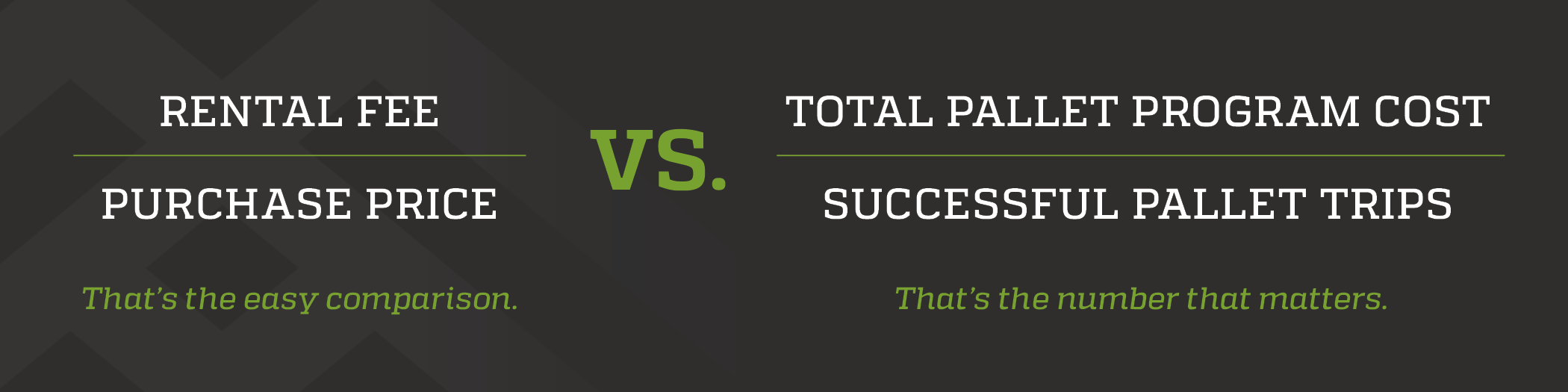
A more expensive pallet may deliver better value if it completes more trips, protects the product more effectively, or prevents operational disruptions. A low purchase price can become expensive if pallets regularly fail, disappear, or require excessive handling.
Questions to Ask Before Choosing a Pallet Procurement Strategy
Before entering a pooling agreement or purchasing a fleet, gather information from procurement, logistics, operations, engineering, finance, and customer-service teams.
Ask:
What pallet specifications does the product require?
Do our customers mandate or reject specific pallet types?
Where do pallets end their trips?
Can empty pallets be recovered from those locations?
How many trips are realistically expected from each pallet?
How seasonal or unpredictable is demand?
How much space is available for empty pallet storage?
What are the current rates of damage, loss, and rejection?
Who will inspect and repair returned pallets?
What reporting or tracking will the program require?
How will each option affect warehouse equipment and automation?
What is the complete cost per successful pallet trip?
The answers may reveal that different parts of the supply chain need different solutions. Some lanes may be well suited to pallet pooling, while others perform better with standard purchased pallets, custom pallets, or a managed recovery program.
Exploring A Third Option: Managed Pallet Ownership
The choice is not limited to a national pallet pool or a completely self-managed fleet.
A managed ownership program allows a business to purchase pallets while working with a pallet management company to coordinate parts of the program.
Depending on the operation, this may include:
Pallet design and sourcing
Inventory planning
Vendor-managed inventory
Scheduled delivery
Pallet retrieval and return
Inspection and sorting
Pallet repair
Recycling
Program reporting
Multi-location coordination
This hybrid approach combines the control of ownership with professional support for the more complicated parts of pallet management.
Evaluate Your Pallet Program to Get Started
Olympic Forest Products can evaluate your current pallet usage, shipment lanes, product requirements, recovery opportunities, and total program costs. We’ll help you compare the options and build a solution around your supply chain—not force your supply chain into a predetermined model.
Ready to evaluate your pallet program?
Submit a Pallet RFP or contact Olympic Forest Products to start the conversation.
Frequently Asked Questions About Pallet Pooling
What is pallet pooling?
Pallet pooling is a shared-use model in which a provider owns reusable pallets and rents or issues them to businesses. After use, the pallets are recovered, inspected, repaired when necessary, and returned to circulation.
Is pallet pooling the same as pallet rental?
The terms are often used interchangeably. Pallet rental describes the commercial arrangement, while pallet pooling describes the broader shared network through which rented pallets circulate among multiple users.
Is pallet pooling cheaper than buying pallets?
It can be, but the result depends on volume, shipping lanes, program fees, pallet loss, dwell time, recovery requirements, and internal operating costs. Compare the total cost per successful pallet trip rather than the rental fee and purchase price alone.
Who owns pooled pallets?
The pallet pooling provider retains ownership. Businesses using pooled pallets must follow the provider’s rules for reporting, transfer, storage, and return.
Can a business own pallets and still outsource retrieval?
Yes. A pallet management company can help retrieve, inspect, repair, and redistribute customer-owned pallets. This can provide many operational benefits associated with pooling while allowing the customer to retain control of the pallet specification.
Are pooled pallets always standard sizes?
Most large pooling systems use standardized pallets to support efficient sharing, inspection, repair, and reuse. Available materials, dimensions, and designs depend on the provider.
Is pallet pooling sustainable?
Pooling can support reuse by keeping serviceable pallets in circulation. Its actual environmental impact depends on pallet lifespan, recovery rates, repair practices, transportation distances, material use, and end-of-life recycling. An owned retrieval and repair program can also support a circular pallet life cycle.